
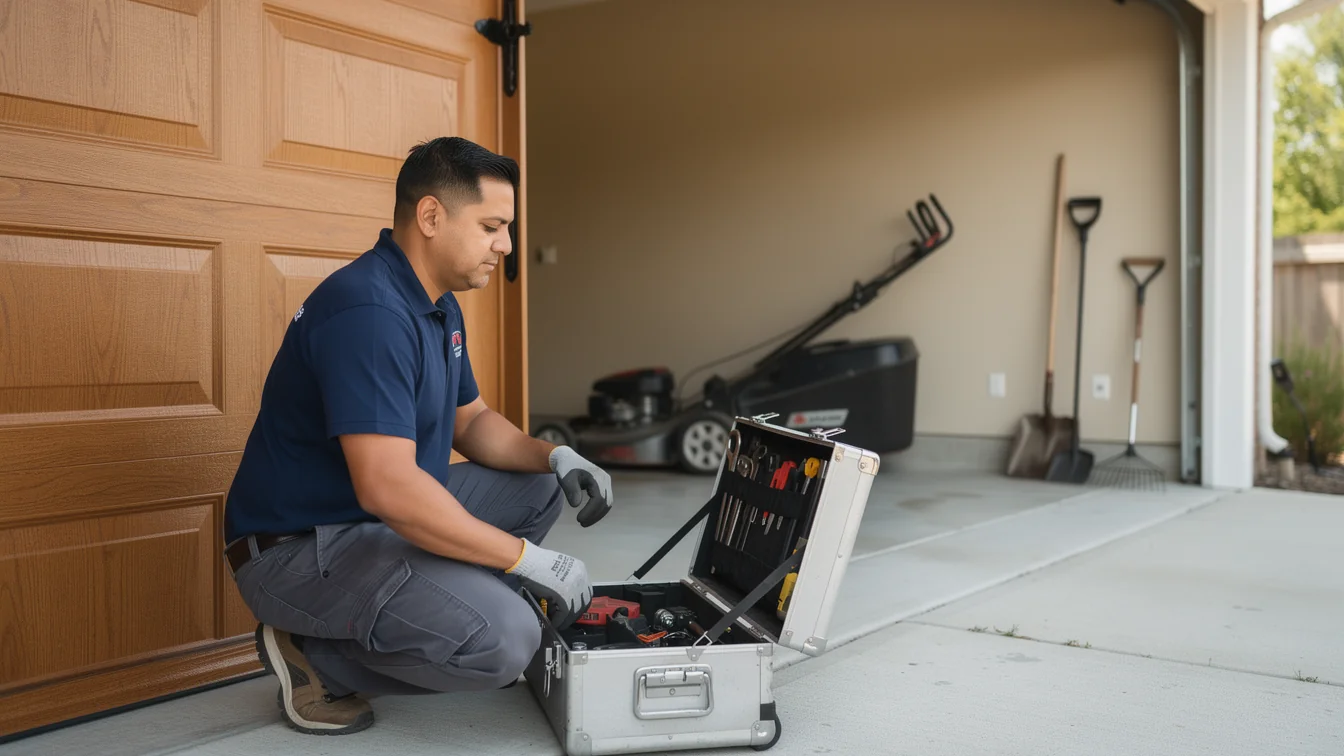
What a Service Call Actually Covers in Nampa
A straight look at what a Nampa Door Pros service call covers, built around Nampa's 1980s-90s housing stock and the cold winters that wear out springs and openers here.
Read moreBlogNampa, ID · 5 min read
Nampa homes built between 1973 and 2009 carry openers and springs sized for a different era. Here's what cold-climate wear actually looks like on these doors.
Local detail
Most of the garage doors we look at in Nampa sit on houses built somewhere between 1973 and 2009, with the median landing around 1990. That's not a small range - it covers three different generations of door hardware, opener wiring, and panel material - but across the twelve named areas we cover, the bulk of what's actually out there is 1980s and 90s construction. That matters because a door from 1985 and a door from 2005 don't share springs, don't share track gauge, and often don't share opener logic boards either.
With 60,492 households in the service area and 38,967 of those owner-occupied houses, a huge share of the doors we see started life as whatever the builder put in at closing - rarely upgraded until something breaks. That builder-grade opener from 1991 is still running fine for a lot of people, right up until the capacitor goes or a gear strips. The median household income here is $66,761, and what we see on calls lines up with that: people fix what's fixable and replace when the math stops working in favor of a patch job.
The area
If your house falls in that 1980s-to-90s band that's common across this area, start with the torsion spring and the opener, in that order. Springs from that era were often sized to the door's original steel gauge, which was lighter than what's installed new today - so a spring swap done without checking the door's actual weight can leave you with a door that slams down or won't stay open on its own.
Next, check the rollers and the track mounting brackets. On a house pushing thirty to forty years old, the original brackets are frequently still lag-bolted into jambs that have shifted slightly over the decades, which throws the whole track out of square even if the door and opener are both fine. A door that drags at one corner is usually a bracket problem before it's a panel problem.
One honest limitation here: if your door is an older steel panel style with foam that's degraded or delaminated inside, we often can't source a matching replacement panel. At that point patch repair isn't worth it and full replacement is the more sensible call, even though it's the bigger ticket.
What we find
This area sits in a climate band rated cold and severe, and that shows up in specific, predictable ways on doors from the 1973-2009 stock that makes up most of the housing here. Steel panels contract in cold snaps, which tightens tolerances at the track and can turn a slightly worn roller into a binding one overnight. Torsion springs wound decades ago lose a bit of tension capacity with repeated cold-to-warm cycling, which is part of why a spring that's lasted fifteen years can suddenly let go in a cold stretch rather than failing gradually.
Weatherstripping is the other piece. On older doors, the bottom seal and side seals were often not rated for the kind of repeated freeze-thaw cycling this area gets, so they crack and harden faster than people expect. Once that seal goes, cold air gets into the garage, and on a lot of these houses the garage shares a wall with living space - so a bad seal isn't just a minor nuisance, it changes the temperature in the room next door. None of this is dramatic failure; it's slow wear that shows up as a door that's harder to lift, louder, or colder-feeling than it used to be.
How we work
We don't have a flat number to quote here, and we're not going to make one up. What drives cost on a door in this area is mostly the age and spec of what's already installed - a 1980s single-car door with a standard torsion spring is a different job than a 2000s double door with extension springs and a newer opener that needs a specific replacement part.
Parts availability is the other factor, and it's the honest limitation worth naming: some hardware from the older end of that 1973-to-2009 range is no longer made, and sourcing an exact match can add lead time to a job that would otherwise be quick. When that happens, the choice usually comes down to a compatible substitute part or moving to full replacement, and we'll tell you which makes more sense for your specific door rather than defaulting to the bigger job. Given the median household income in this area, we try to lay out both paths plainly before any work starts, so the decision is yours and it's based on your actual door, not a guess.
Questions
A torsion spring loses a bit of tension capacity over years of cold-to-warm cycling, which is common in this climate band. On a door from the 1980s-90s stock that makes up most of this area, that gradual loss is often the first sign a spring is near the end of its life, not a sign something else is broken.
Yes - we cover out to Caldwell about six miles away, Star and Kuna around nine miles, Middleton at nine, and further out toward Eagle, Garden City, Melba, Notus, Wilder, Homedale, and Emmett, which runs up to about twenty miles. Drive distance can factor into scheduling on the farther calls.
If the panel foam has degraded or delaminated, matching replacement panels are often hard to source for older doors, and a patch repair isn't worth it at that point. A newer door, or one with intact panels, is usually a better repair candidate. We'll look at the specific door before recommending either path.
This area sits in a severe cold climate band, and repeated freeze-thaw cycling wears torsion springs down in ways that aren't visible day to day. A spring that's held up for over a decade can reach its limit during a cold stretch, which is why winter breakage often looks sudden even though the wear built up gradually.
Recommendation
More garage door guides for Nampa homeowners.
A straight look at what a Nampa Door Pros service call covers, built around Nampa's 1980s-90s housing stock and the cold winters that wear out springs and openers here.
Read more
Nampa homes built between 1973 and 2009 use opener and spring hardware that ages differently in Idaho's cold winters.
Read more
How Nampa's 1973-2009 housing stock and cold-severe winters affect garage door openers during power cuts, what to check first, and what actually costs money to fix.
Read moreReady when you are
Nampa Door Pros repairs and installs garage doors, springs and openers in Nampa, ID and the surrounding area.